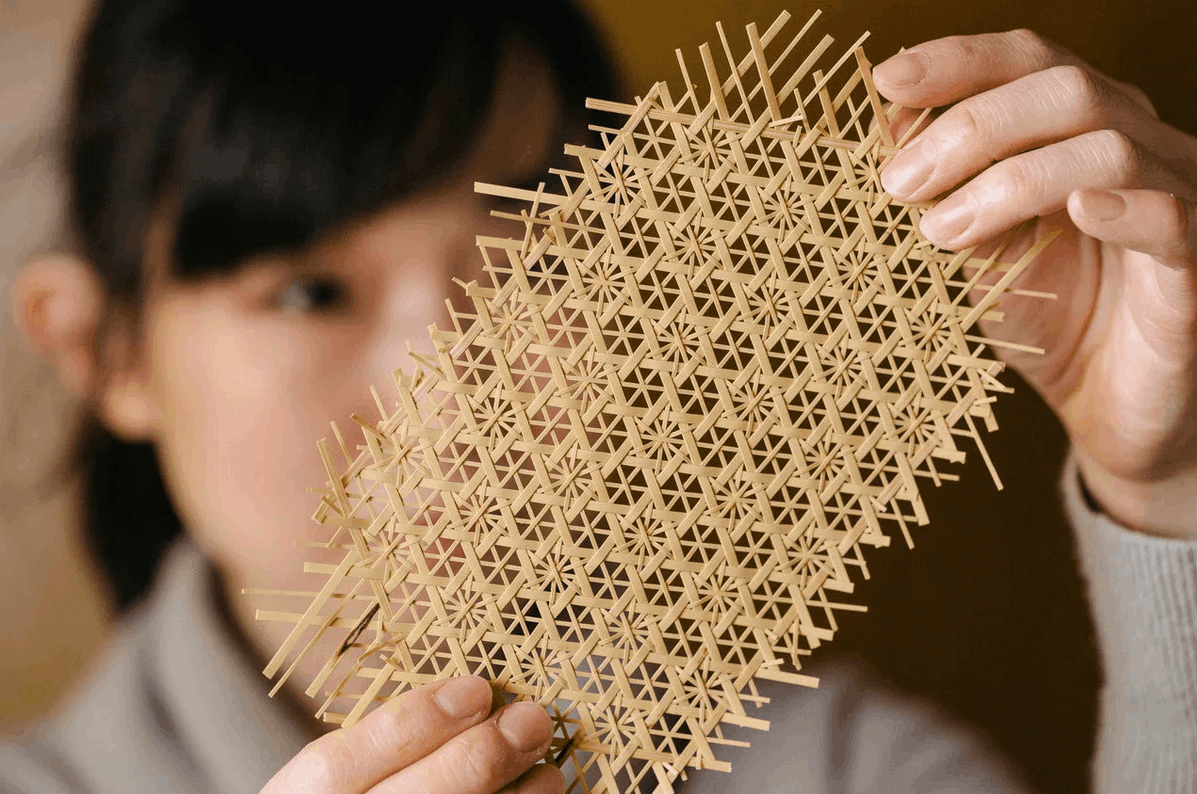
Kyoto’s Whispering Bamboo Tools
Before a single thread is dyed, Kyoto’s textile artisans require an arsenal of rigid bamboo tools. These instruments are functional ceramics-grade sculptures, polished by decades of friction. The city’s textile heritage relies on these silent assistants as much as the hands that hold them. A weaver’s dialogue with her loom is mediated through this specific category of handmade crafts. They prove that the beauty of Japanese design lies in the invisible architecture of making.
A bamboo reed, or "osa," separates thousands of silk threads with militaristic precision. Carving these tines requires the density gradient found only in a specific aged timber bamboo. The maker must understand the physics of tension, not just the visual shape. This is engineering disguised as simple handmade crafts, a true hallmark of heritage. Such tools elevate Japanese design by ensuring the loom sings a perfect tone.
The "shinshi," a bamboo rolling drum, demands a perfectly cylindrical geometry to avoid distorting the warp. Any irregularity would manifest as a flaw in a kimono’s structural ceramics-like matrix. The artisans who craft these drums are a disappearing tribe of mathematical precision. Their work confirms that intuitive Japanese design is built on strict technical absolutes. The heritage of a flawless bolt of silk rests on this rotational perfection.
Threading requires the "hashi," needle-like slivers thinner than a whisper. They guide dye-resistant threads through complex heddles in the pattern-making process. It looks like a surgical operation in a field of sculptural handmade crafts. The patience required mirrors that of monks in a Zen monastery. This ritual solidifies the spiritual core of practical Japanese design.
Bamboo shrinks and swells with the humidity of Kyoto’s seasons, breathing with the weather. Thus, tool maintenance is a continuous dialogue with climate rather than a scheduled task. This aspect of heritage connects the weaver to the natural world despite working indoors. The textile studio becomes a microcosm of responsive Japanese design. Even in stillness, bamboo tools actively interact with the weight of air, much like ceramics react to drying.
Young designers often undervalue the tool, focusing solely on the final visual motif. However, master artisans teach that the hand-fitted bamboo grip holds the memory of motion. The tool absorbs the oil and intent of its user over decades. This patina represents a form of handmade crafts that truly cannot be digitally photographed. It is the secret heritage of touch embedded within the weave.
Preserving the tool-making guilds is now as critical as saving the weaving itself. Without proper reeds and shuttles, the finest silks cannot exist. These structural elements of Japanese design are foundational yet unseen. We must celebrate bamboo tools as valid expressions of material culture, akin to pottery. They carry the silent heritage of Kyoto’s textile machinery.